Copenhagen
Smilla's Sense of SnowCopenhagen is the city where Smilla lives among Greenlanders and Danish institutions, investigates Isaiah’s death, and confronts the limits of a life organized around fixed rooms and official explanations. It is not merely a backdrop: its streets and agencies make the investigation possible, while its prisons, housing, and social hierarchies sharpen the contrast between Danish urban order and the spatial freedom Smilla remembers from Greenland.
City and divided setting
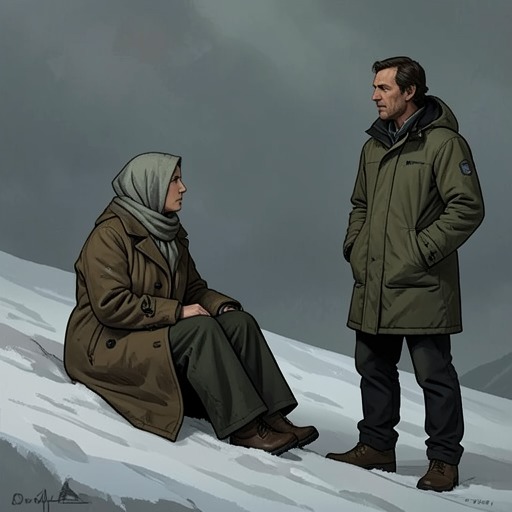
At Isaiah’s funeral, the apparent setting briefly seems to be Greenland. The pastor and verger are Greenlanders; the mourners sing in Greenlandic, Juliane’s grief breaks through her attempted composure, and the pastor speaks in West Greenlandic. The scene evokes Upernavik, Holsteinsborg, or Qaanaaq, but its actual location is Copenhagen: beyond the darkness, Vestre Prison’s walls loom like the bow of a ship. The Greenlanders’ cemetery is part of Vestre Cemetery, and the procession follows Isaiah’s coffin through a Copenhagen landscape shared by Greenlandic mourners and a small group of Danes. The city therefore holds two cultural worlds in close physical proximity without making them interchangeable.
That division is also present in the White Palace, where Smilla lives with Juliane and the mechanic. The Housing Authority has built a row of prefabricated white concrete boxes on donated land and received an award from the Association for the Beautification of the Capital. The prize sits awkwardly beside the buildings’ cheap, flimsy appearance; their rent, by contrast, is high. The state supports Juliane, the mechanic has had to take what he could get, and Smilla lives on the edge. The housing is at once a practical home and a visible measure of constrained choices within the city.
Streets, water, and the investigation
Copenhagen’s winter geography is legible to Smilla through ice. When she comes onto Knippels Bridge, she normally looks first at the water and reads the developing freeze: at 29°F, the sea begins to form crystals, which break into frazil ice, gather into grease ice, and spread as pancake ice before freezing into a sheet. The process matters to her not only as weather. She understands the ice as a living structure, with crystals forming bridges and salt water enclosed in pockets through which liquid slowly seeps.
On the December day when Isaiah’s body is found, the expected view from Knippels Bridge is interrupted by a light. A faint yellow glow reflects brightly against the snow at the base of a warehouse left standing when the apartment blocks were built. Near the building, toward Strand Street and Christianshavn, a patrol car’s blue light revolves beside a cordoned-off area; a small dark shape lies in the snow. Smilla is running and reaches the scene several minutes before the ambulance. The shift from watching the ice to seeing the body turns familiar urban observation into the beginning of the novel’s central investigation.
That investigation carries her into the city’s institutional geography. After calling police headquarters, she is transferred to Division A, where the Toenail tells her she can see Isaiah in the morgue and speak to the doctor, Loyen. She later walks along Frederik V’s Street, past the Teilum building and the Institute of Forensic Medicine, to the University Hospital’s new annex. An elevator carries her past the Greenland Medical Association, the Arctic Center, and the Institute for Arctic Medicine to the sixth-floor suite marked State Autopsy Center for Greenland. The designation places Greenlandic death inside Copenhagen’s administrative and medical architecture; Smilla’s questions must pass through that architecture even as she distrusts its conclusions.
Confinement and spatial freedom
The city’s power is most explicit in its capacity to imprison. Smilla is told that a little soundproof room without windows is particularly uncomfortable for someone who grew up in Greenland. In Greenland, she explains, there are no prisons; offenses that would lead to imprisonment in Denmark more often result in fines. The contrast is not simply between two penal systems. For Smilla, the locked room is a specifically Greenlandic image of hell, opposed to childhood memories in which people seemed never to be indoors.
Her mother could not imagine living in the same place for long, and Smilla feels the same protectiveness toward spatial freedom. She describes it as something cherished with the intensity other people might reserve for their bodies. When her investigation into Isaiah’s death reaches its end, that threat of confinement has particular force: the city’s institutions can close the case, restrict movement, or make a room the instrument of control. Copenhagen’s built environment thus becomes part of the conflict between official authority and Smilla’s need to remain free to move and judge for herself.
Memory, culture, and the city’s limits
Copenhagen is also where Smilla’s account of Greenlandic life repeatedly tests the limits of explanation. In her father’s apartment, she recalls stories and records that resist neat divisions between male and female roles. An Inuit account told to Knud Rasmussen describes two male sorcerers, one of whom transformed his body so that he could give birth. Historical records describe women hunting as men did, although such women generally had to dress as men and renounce family life. Smilla sets these accounts against her mother’s life: she gave birth, cared for skins, and took part in ordinary women’s work, but also shot, paddled a kayak, and hauled meat home like a man.
The story of Smilla’s mother makes such knowledge concrete. When her grandfather began losing his sight, the family faced the possibility of starvation or dependence on relatives who had little to spare. Her mother stayed behind after he missed a seal and, when it surfaced again, shot it. Smilla’s memories of hunting continue through the killing of birds for food: after twenty-four hours without eating, she catches three on her second attempt, then sees the relation between the birds, their young, and a narwhal pup as a chain of living gazes. She overturns the net and lets the birds go. These scenes do not turn Greenland into an abstract ideal; they show how survival, kinship, and attention are learned through particular acts and consequences.
Against that lived knowledge, Smilla rejects ranking cultures by measures designed by European science. For her, understanding another culture requires living within it, asking to be tolerated as a guest, and learning its language. Once something foreign is genuinely grasped, she argues, the impulse to explain it falls away. Yet in Copenhagen she also feels the temptation to tell another person why she is connected to Inuit life: its capacity to hold contradictions without seeking a simplified resolution, and its unprejudiced clarity in meeting another person. She recognizes that happiness in the present makes her hope that someone can also contain her past. The city is where that hope and its limits become visible: it is home, the site of an investigation, and the place from which Smilla repeatedly measures what cannot be reduced to Danish institutional categories.